


Jump Starter with Air Compressor: 2-in-1 Emergency Tool Guide
Two of the most common roadside emergencies are dead batteries and flat tires. A jump starter with a built-in air compressor tackles both in one compact device. But is a combo unit really as good as two separate tools? This guide breaks down the pros, cons, and what to look for.
What Is a Jump Starter with Air Compressor?
These are combination devices that integrate a lithium jump starter with a portable air compressor. The jump starter function works exactly like a standalone unit — delivering 1,000-2,000 peak amps to crank your engine. The air compressor function can inflate tires, sports balls, air mattresses, and other inflatables.
Most units also include USB ports for device charging and an LED flashlight, making them a complete roadside emergency tool.
Benefits of a 2-in-1 Jump Starter and Air Compressor
Space Efficiency
Instead of carrying a separate jump starter, air compressor, and power bank, you get all three in one device. This is especially valuable if you have limited trunk space or drive a smaller vehicle.
Cost Savings
A combo unit typically costs $100-$200. Buying a quality jump starter ($80-$150) and a portable air compressor ($40-$80) separately would cost $120-$230. The combo unit saves money and gives you one device to maintain.
Always Ready
With one device, you only need to remember to charge one thing. Set a quarterly reminder, and both functions are ready when you need them.
Versatility
Beyond roadside emergencies, the air compressor is useful for: bike tires, motorcycle tires, ATV/UTV tires, sports balls, pool toys, air mattresses, and inflatable kayaks.
Limitations to Consider
Compressor Power Limitations
The air compressors built into combo units are typically 12V piston or diaphragm compressors rated for 120-150 PSI max output. They're fine for car tires (32-35 PSI) and SUV tires (35-40 PSI), but they'll struggle with:
- LT truck tires (50-80 PSI) — will work but slowly
- RV/trailer tires (65-80 PSI) — may not reach full pressure
- Semi-truck tires (100+ PSI) — not suitable
- Large off-road tires — will take a very long time
Battery Drain
Running the air compressor draws significant current from the jump starter's internal battery. Inflating four tires from 28 to 35 PSI can drain 30-40% of the battery. Always recharge after using the compressor to ensure you have enough power for jump starting.
Heat Buildup
Small compressors generate significant heat during continuous operation. Most units recommend running for no more than 8-10 minutes continuously, then allowing 10 minutes of cooling time. For inflating multiple tires, work in intervals.
Size and Weight
Combo units are larger and heavier than standalone jump starters. Expect 2-4 lbs vs 1-2 lbs for a jump starter only. They may not fit in a glove box and typically live in the trunk or cargo area.
Key Features to Look For
1. Digital Tire Pressure Gauge
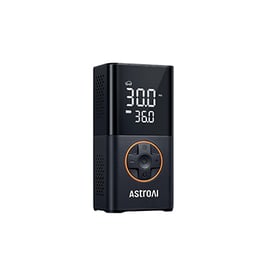
A built-in digital gauge that auto-shuts off at the target pressure is the single most valuable feature. You set the desired PSI, press start, and the compressor stops automatically. This prevents over-inflation and saves you from constantly checking with a separate gauge.
2. Multiple Valve Adapters
Look for units that include adapters for Schrader valves (car tires), Presta valves (bicycles), needle valves (sports balls), and a raft/inflatable adapter.
3. Sufficient Jump Starter Amps
Don't compromise on jump-starting power for the sake of the compressor. Look for at least 1,500 peak amps for cars and SUVs, 2,000+ for trucks.
4. Large Internal Battery
A 20,000+ mAh battery ensures you have enough power for both jump starting and tire inflation. A combo unit with a large battery can handle multiple emergencies on a single charge.
5. High-Pressure Hose
A flexible, high-pressure hose (at least 18 inches) makes it easy to reach all four tires without repositioning the device.
Combo Unit vs Separate Tools: Which Is Better?
| Factor | Combo Unit | Separate Tools |
|---|---|---|
| Cost | $100-$200 | $120-$230 |
| Space | One device | Two devices |
| Convenience | One charge, one device | Charge both separately |
| Jump start power | Same (1,500-2,000A) | Same |
| Compressor power | Moderate (120-150 PSI max) | Higher if dedicated compressor |
| Duty cycle | 8-10 min continuous | 20-30 min continuous |
| Battery drain | Compressor uses jump starter battery | Independent batteries |
Choose a combo unit if: You want to save space and money, and you mostly drive a passenger car or SUV in urban/suburban areas.
Choose separate tools if: You drive a truck with high-pressure tires, go off-roading, or need maximum jump-starting power without compromise.
How to Use the Air Compressor Function
- Check current tire pressure — use the built-in gauge or a standalone gauge.
- Set target pressure — on units with auto-shutoff, set the desired PSI (typically 32-35 for cars, 35-40 for SUVs).
- Connect the hose — screw onto the tire's Schrader valve.
- Start the compressor — it will run until reaching target pressure.
- Don't exceed 8-10 minutes of continuous operation — let the unit cool for 10 minutes between tires if needed.
- Recheck pressure — use a separate gauge to verify accuracy.
- Recharge the jump starter after inflating tires to ensure jump-starting power is available.
Real-World Performance: What to Expect
Most combo units can inflate a standard car tire (205/55R16) from 28 PSI to 35 PSI in about 3-5 minutes. An SUV tire (265/65R17) takes 5-8 minutes. If you need to inflate all four tires, expect the process to take 20-30 minutes with cooling breaks.
For daily tire maintenance (adding 1-2 PSI), the compressor is quick and efficient. For completely flat tires, expect 10-15 minutes per tire — and be mindful of battery drain.
Maintenance Tips
- Recharge every 3 months — compressor use drains battery faster than jump starting
- Keep hose clean — dirt in the valve causes inaccurate readings
- Store with hose disconnected — prevents kinks and damage
- Check gauge accuracy yearly — compare with a known-good tire pressure gauge
- Don't run compressor without load — always connect to a tire before starting
Explore our jump starter collection to find a unit with the features you need.
Frequently Asked Questions
Can a jump starter air compressor inflate truck tires?
Yes, but slowly. Most combo compressors max out at 120-150 PSI and have limited duty cycles. For LT truck tires (50-80 PSI), expect 8-15 minutes per tire with cooling breaks.
Does using the air compressor affect jump starting?
Yes. The compressor draws power from the same battery as the jump starter. Inflating four tires can drain 30-40% of the battery. Always recharge after compressor use.
Is a combo unit worth it?
If you value space efficiency and want both tools in one device, yes. If you need maximum compressor performance or drive a truck with high-pressure tires, separate tools are better.